M LE MONDE

THE ELECTRIC COUNTERS OF SOPHIE HICKS

Words by Clément Ghys. Photography by Timothée Chambovet. April 2026

A stylist and journalist turned architect, a figure of 1980s–1990s London, the British designer imagines unconventional spaces for fashion brands, infusing them with her minimalist and rigorous aesthetic. A case in point: the Paris boutique of the Italian label Max Mara on Avenue Montaigne, which she has just reinvented.


According to Sophie Hicks, a ceiling can only be a flat surface. The architect detests the “hideous smoke detectors” imposed by regulations. As a result, on her building sites, the 65-year-old Englishwoman always assigns a member of her team to find ways of integrating them as discreetly as possible. All of this comes at a cost. But in her projects, the question arises less than elsewhere, as the architect works primarily for the world of luxury. Take her latest project: the renovation of the Paris boutique of the Italian house Max Mara, at 31 Avenue Montaigne, in the 8th arrondissement. More than 700 square meters spread across the ground and first floors of a 1970s concrete building have been reinvented with lavish materials: marmorino, a lime-based plaster flecked with stone fragments from the Verona region; translucent walls in a blackberry hue; pebbles imported from Italy and set into the floor at the entrance.

On this early April day, dressed in a strict double-breasted grey jacket—standing in contrast to the soft, warm-toned suits of the sales staff—Sophie Hicks bustles about the boutique. She checks the cleanliness of a pane of glass, observes the condition of the shrubs outside, points out variations in the light. Above all, she proudly indicates the centerpiece: a monumental double-helix spiral staircase in bright orange. “This isn’t just any shade of orange,” she says. “It’s vivid! Dazzling! Electric!” With that upper-
class English accent perfectly suited to wit and calculated irreverence, she explains that she “wanted to shake up camel,” the house’s signature color, found in its famous coats. “Why not imagine the same camel—but on acid?”

The brand—an emblem of steady Italian luxury, of elegance that transcends fashion trends— loved it. Maria Giulia Prezioso Maramotti, granddaughter of the founder and deeply involved in the family business, praises Hicks’s “sensitivity” and her “ability to translate complex architectural concepts into pure, powerful forms.”

“I know shops,” Hicks says with a smile, moving from mirror to display. While she also designs residential projects—she built her daughter, model Edie Campbell’s house in the
Northamptonshire countryside, as well as her own, a block of glass and concrete nestled among listed houses in West London—she is a sought-after signature among luxury brands.

In 1998, she transformed a derelict house in London’s Kensington district into a multicolored store for Paul Smith, where children were invited to ride tricycles. Four years later, at the request of Phoebe Philo, then creative director of Chloé, she designed boutiques with plywood-covered walls, defying the idea that luxury must rely on expensive materials. Are display windows essential? In 2008, she covered those of Yohji Yamamoto with white Japanese paper.

“In reality, I always work the same way,” she explains. “I ask questions—thousands of questions—to the CEO, the communications team, marketing, the workshop. I want to understand everything. Just like in a private project, where I ask the client if they cook, entertain, work from home—and then adapt the space accordingly.” For Max Mara, she immersed herself in the archives, held long discussions with Ian Griffiths, the discreet artistic director who has worked there for nearly four decades, and visited the Collezione Maramotti museum in Reggio Emilia, owned by the founding family.

She is delighted to present, as a counterpoint to the orange staircase, a retro backlit linen screen broadcasting live weather conditions from the Emilia-Romagna region—cloud cover, humidity, heat—all reflected in the Avenue Montaigne space. It’s unlikely customers will recognize the Italian climate, but that isn’t the point. What matters is a certain taste—Sophie Hicks’s taste: a minimalist, conceptual aesthetic without being cold, appreciated by connoisseurs.

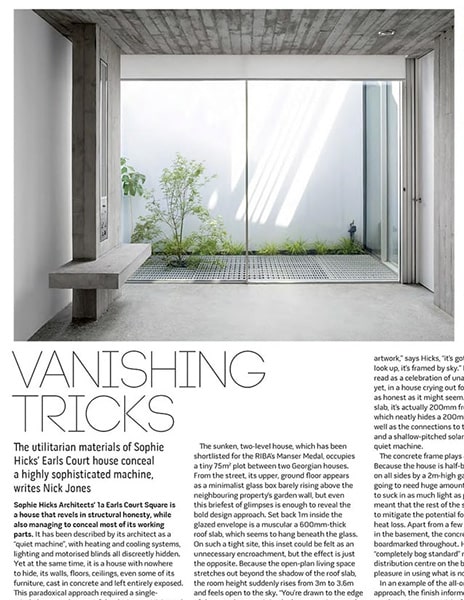
She favors raw materials, fence planks, metal, restrained environments where the colors of abstract artworks burst forth, and trompe-l’œil effects—like the additions to the building’s concrete columns that double as shelves. She doesn’t just dislike fire detectors; she also has a distaste for LED lighting (which she covers with tape when visiting sites) and coffee tables (“I’m allergic to them, because as soon as you have one, you feel compelled to put something on it”). She points to a table made of pinkish copper and smiles, as if uttering a swear word: “It’s camel—but not on acid. On another drug, I’m not sure which. We played with the bad taste of that color. You need a little vulgarity.”

Her own path, however, is anything but vulgar. Barely out of adolescence, she began working for London magazines as a stylist, collaborating with renowned photographers on fashion shoots. At the time, the magazine press was at its peak, with budgets rivaling film productions. London in the 1980s was buzzing, and like others whose names still resonate in fashion circles (Amanda Harlech, Isabella Blow…), she brought her generation’s inventiveness to prestigious publications such as Tatler, eventually working at Vogue—sometimes arriving at the office in pajamas.

In 1984, the English photographer David Bailey, a legend of Swinging London, shot her portrait for the cover of i-D magazine, her right eye covered with black tape. The image is still considered emblematic of the decade.

“And then I got fed up,” she says. “The industry was changing. As a stylist, you have an expiration date.” She worked for a time with Azzedine Alaïa, from whom she says she learned two things: “First, precision—he cared about every detail. And also that if you want things done properly, you have to do them yourself.” She recalls the Franco-Tunisian designer working late into the night at his table, endlessly reworking the pattern of a dress.

Then came a change of life. In 1990, she enrolled at the Architectural Association in London, alma mater to major figures such as Ron Arad, David Chipperfield, and Zaha Hadid. “I really began as an architect at the moment when the luxury sector exploded.” In the early 2000s, the fashion industry expanded worldwide, erecting monumental boutiques across North America, Europe, and Asia, often designed by star architects. “Fashion became a religion at that point,” she says, somewhat amused by the current homogenization of stores around the world.

She prefers the “little shops” she once frequented in London—like Joseph, opened in the late 1970s by the Ettedgui brothers next to their family hair salon, or Anthony Price’s boutique, the glam-rock costumier, where the designer stood behind a counter like in a post office, presenting new pieces hanging from the ceiling.

“The shop was tiny—like this fitting room,” she exclaims, stepping into one. “It’s a crucial place. Especially the mirrors, because we all want to know if the trousers make our bottoms look good.” She smiles again, then suddenly pauses, concerned. She moves a vase a few
centimeters, studies it, then repeats the gesture. Everything is in order.

View PDF >>

CONCRETE QUARTERLY

VANISHING TRICKS
by Nick Jones
Photographs by Annabel Elston and Sophie Hicks Architects
Winter 2019

KINFOLK MAGAZINE

4 NECESSARY EVILS – Competitiveness
By Pip Usher
Photographs by Marsý Hild Þórsdóttir
December 2016

PIN-UP

SOPHIE HICKS – THE ALAÏA-CLAD STYLIST WHO REFITTED HERSELF AS AN ARCHITECT
By Emily King
Photographs by Andreas Larsson
Fall/Winter 09/10

NOWNESS

IN RESIDENCE: SOPHIE HICKS​
Editor Shelley Jones
Film by Nick Ballon
January 2019

FRÄULEIN MAGAZINE

SOPHIE HICKS, WAS WÜRDE SOPHIE TUN?
By Aicha Reguieg
Photographs by David Fischer
April 2012