
KINFOLK MAGAZINE
4 NECESSARY EVILS – Competitiveness
By Pip Usher
Photographs by Marsý Hild Þórsdóttir
December 2016
When the fashion world needs a new building, it is Sophie Hicks it calls. The former editor turned very excellent British architect, 65, has created singular spaces for Chlo. (plywood), Acne (translucent polycarbonate), Max Mara (terrazzo) and Yohji Yamamoto (shoji paper). Her most difficult client to date? Herself, of course (concrete).
On the high-ceilinged first floor of a 15th-century palazzo in central Venice, the architect Sophie Hicks has unpacked the latest incarnation of her life. “I’ve hardly done anything to it,” she says of the courtyard-facing apartment she has been renting for the past three years. “It came with this nice floor and the walls painted white. I’ve brought all the furniture that I had in store in London, plus one or two other things, and dumped it down.” Sophie is big on storage. “Because I’m a nutcase, anything that I think has some value, I put it in a box, label it and put it in my storage unit.”
Sophie used to live in a Notting Hill warehouse that she had converted to accommodate both her office and home, but 10 years ago, with her three children grown up, she took the opportunity to build a house for herself. Formerly occupied by garages, its site on the edge of Earl’s Court Square is enviably located but by no means large, and building was further constrained by its being in a conservation area. A triumph of infill site planning, her design shoehorns a couple of basement bedrooms around a tiny lightwell and screens the glazed ground floor from the street with a high wall. It is a house that makes demands of its occupants – until she had the Venice flat, all Sophie’s books were in storage – but one that offers beautifully detailed concrete surfaces, an ingenious use of daylight and a protective refuge from the outside world.
Sophie continues to live there for part of the year, in large part so she can see friends and the children she shares with her former husband, the financier Roddy Campbell. Arthur, 37, is a software engineer; Edie, 35, is a celebrated model and equestrian; Olympia, 30, who also modelled, is a research scientist in Toulouse. But London no longer holds the charm for Sophie that it once did. “Until I was about 40, I couldn’t go out of my house or office without meeting friends and having a chat. Now I go out and I think, Who are all these people? Venice is still like a village. It’s an international village, but you bump into people.”
Her practice remains registered in the UK, but its commissions are spread far and wide. Many – like the recently completed stores for Max Mara in Paris and the South Korean perfume company PointTwoFive Second in Seoul – are for fashion brands. Among her longest-standing clients is Paul Smith, for whom she turned a dilapidated 19th-century townhouse in Notting Hill into a flagship store in 1998. A beautiful shop, says the architect Nigel Coates. “It had little foci of flamboyance – a flocked chandelier, which wasn’t an everyday object. And the fact that it was a house… She does that kind of thing with great panache.” Sophie has since designed stores around the globe for Paul Smith, in cities including Tokyo and Milan. “Sophie’s ability to observe things from the past and bring them a modernity and freshness is very rare,” Smith tells me by email. “Combine this with her no-holdsbarred attention to detail and she is extremely unique.”
There are persistent preoccupations in her architecture – balletically unfolding staircases; glowing, lantern-like facades; the conjunction of rough and refined materials – but designing spaces for the fashion world requires a capacity for selfeffacement. “These companies all occupy a very congested, overlapping, competitive field, so you have to work with the creative director and establish their identity. You ask lots of questions with the aim of showing the client a version of themselves that they can recognise. Then I can answer when they ask, ‘Do you think this door should be wood?’ Why do you want wood? We’ve already established that you are medical, scientific, you’ve got rigorous thinking, everything’s clean and crisp. What’s wood got to do with it?”
With residential clients – who in Sophie’s case have ranged from Yasmin and Simon Le Bon to Molly Dineen and William Sieghart – the questions become more intimate. “I ask them how they live, from the moment they open their eyes in the morning to when they go to bed. Do they walk barefoot or put on slippers? Do they like to sleep with the curtains open and be woken by light? How do they cook, and where do they like to stand in a kitchen?”
Sophie’s father, Richard Hicks, had a fruit distribution business; her mother, Joan, had been a successful model in the 1950s who worked with the photographers Norman Parkinson and John French. Growing up in Kensington, west London, Sophie was enmeshed in globally influential youth cultures. “Kensington High Street was amazing, the King’s Road was amazing. There was no fast fashion in the 1970s, so you either saved up for something that might cost an astronomical sum, like Åí40, or you went to Kensington Market, which was full of people with little stands who bought stuff, cut it up, restitched it on their dining room table. It was very exciting.”
In 1978, Harpers & Queen magazine hit on the idea of producing an issue guestedited by teenagers, and Sophie, then 17 – having just left boarding school in Surrey – was one of its recruits. She stayed
at Harpers & Queen, taken on by the editor, Willie Landels, for its Shopping Bazaar pages, before moving to British Vogue as Grace Coddington’s assistant. “I learned a lot from Grace,” Sophie says. “She was so precise and refined.” Before long, Mark Boxer, then editing Tatler, poached her. It was her big break. At Tatler, a magazine she remembers as unusually willing to take risks, she worked with photographers including Arthur Elgort, Paolo Roversi, Peter Lindbergh, Bruce Weber and David Bailey, building a reputation for pictures that were more adventurous than conventional society-magazine fashion images.
By the mid-1980s, Sophie found herself tiring of the cycle of fashion. “I thought, I’d love to do something I can do forever, where I don’t have a sell-by date.” She toyed with the idea of working in film, and through her friend Dado Ruspoli, a central inspiration behind Federico Fellini’s La Dolce Vita, she secured a meeting with the Italian director. She had hoped to land a job as an assistant, but Fellini announced his plans to adapt Kafka’s Amerika with her as the 16-year-old male protagonist. (The money didn’t materialise, but she does make a brief appearance in 1987’s Intervista.)
Instead, she moved to Paris to style photographs for Azzedine Alaïa, who she had met when she attended one of the first shows he staged in his apartment on the rue de Bellechasse. The audience, crammed into corridors on little gold chairs, waited for hours before Janice Dickinson’s heel announced the start. “Out came these incredible clothes on these incredible models. He’d got these girls to get on planes at their own expense – he didn’t have money. The clothes were so good they just wanted to be part of this new birth of something.” She spent a couple of years working with Alaïa before returning to London in 1987, having met her future husband.
Architecture had been an interest since Sophie had encountered the Roman temple complex at Baalbek on a trip to Lebanon when she was 13, and the thought of joining the profession had even led her to struggle through A-level maths. But she was 27 when she finally went for her interview at the radical Architectural Association, dressed in top-to-toe Alaïa. “I said, ‘I am awfully sorry, I don’t have a portfolio, but I do have my fashion show sketchbooks. This is Versace, this is Alaïa, this is Miyake. And I’m sorry a lot of them don’t have heads or feet, as I didn’t have time because the models were moving so fast.’ They looked at me as if I was a Martian.”
Half the jury thought she wouldn’t last five minutes, but after much debate they offered her a place. “Having achieved a lot in fashion, to decide to navigate the AA for a full five years is completely admirable,” Nigel Coates says. “That’s somebody who knows what they want.” Sophie was conscious of not wanting to stand out. She remained guarded about her professional history. “I’m quite good at disguise.” In her third year she began receiving commissions and decided to set up a firm of her own.
A figure of arresting androgynous beauty, Sophie has frequently found herself in front of the camera. Sporting her habitual short hair, masculine wardrobe and makeup- free face, she featured on a 1984 i-D magazine cover, shot by David Bailey, one eye patched with gaffer tape. She had had her hair cut short at nine. “Before then I’d had these terrible curtains of long hair with a fringe, and I’d always felt horrible. But then when I cut it everybody thought I was a boy, and I didn’t like that.”
She went through years of wearing pretty dresses – “and I looked OK” – but she was 19 before she found a look she was comfortable with. The unlikely setting was the marriage of Prince Charles and Lady Diana Spencer in 1981. Sophie’s then boyfriend, the journalist – and later publisher – Nicholas Coleridge, was due to cover proceedings for the London Evening Standard, and Sophie, having noticed that his invitation made reference to a driver, decided to play the part. George Christie, who ran Glyndebourne opera house, was a family friend, and she knew he owned a chauffeur’s cap. “When George was pissed, he used to say to his wife, Mary, ‘You get in the back. I’ll sit in the front with the cap on and they won’t stop us.’ So I borrowed George’s cap and one of Nick’s suits, grey flannel from the Fulham Road boutique Piero de Monzi. I had a yellow Daihatsu jeep with an open top, and ours was one of the first vehicles to go down the Mall early in the morning. The crowds had been sleeping there all night and began cheering like crazy. Afterwards we ended up at a party, and everybody thought this look of mine was great. I thought, Maybe a man’s suit is OK.”
A heatwave is in progress when I visit her in Venice, but Sophie’s apartment is blessedly shuttered, slivers of light slicing across its terrazzo floor. She keeps a boat five minutes away and the day before had ventured out into the lagoon with a friend for a cooling swim. Sophie is warm, funny and forthcoming. Today she is dressed all in black – trousers and T-shirt from Arket, loafers from Bowen – offset by a gold pendant of an Ordos wild cat hung on a leather bootlace. Her vast living room is filled with modern prints and furniture, including a white sofa given to her by a friend, a leather Cab sofa by Mario Bellini and, most strikingly, a sculptural lamp of her own design in aluminium honeycomb.
For all her deserved reputation in the fashion world, her profile on the British architecture scene remains surprisingly low. The only projects she has realised in the UK in the past 20 years have been for herself or family members. She recently designed and built a house for her daughter Edie, discovering along the way that they “got on very well working together”. Few of her friends are in the profession. Nigel Coates, one of those few, says she hasn’t received the recognition she deserves. “Among architects shops still have this weird in-between status. Somehow, they count less than if you’re building a museum or an opera house.” The lack of acknowledgement is all the more striking given that when she set up her company in 1990 female-led practices were all but unheard of. “There still aren’t many,” Sophie says. “It’s ridiculous; architecture is one of those things where you have to combine many different skills. You have to be able to design, to think, to be practical, to manage time, to manage budgets and to have a huge amount of common sense. Women are very good at that. Women are good at looking after children, managing the house, making sure hubby’s not in a grump, getting the shopping in. We’re very well suited to being architects.”
From the start, her office has taken on exhibitions. She designed Sensation, the landmark survey of Young British Artists at the Royal Academy, at the request of Charles Saatchi, whose collection it was. “They were very punchy works, and I believed they should have a simple as possible background.” So she undertook a complex clean-up exercise that included the removal of tarpaulins from the Victorian roof lights and the demolition of later partitions. “But when it is announced that it will open on September 8th, you can’t delay it. If the shark doesn’t get to the top of the stairs, too bad. So it does get up there. Everything happens.”
Video conferencing has been a liberation. “Thank God we’re free of all that trucking from one side of London to the other to sit with mechanical services engineers. No more coffee, and where’s the toilet?” Her core team comprises just three other people: Tom Hopes, her principal collaborator; Ema Bonifacic, who focuses on the early development of concepts with clients; and Carsten Jungfer, who has designed all the furniture for her stores, going back to the first work for Paul Smith. International projects, which make up the majority of her work today, are all delivered in collaboration with executive architects on the ground. Remaining lean was a deliberate choice. It also allows her to maintain control. “If somebody asks me to design something for them, they get me, not the third assistant.”
One particular attraction of her Venetian life is the city’s abundance of skilled furniture makers, metal workers and glassblowers. We head for lunch at the studio of her friend Marie-Rose Kahane, whose company, Yali, Sophie considers to be producing the best contemporary glassware in the city. Following the completion of two recent projects, Sophie is taking the time to make things by hand herself, including a design for another light fitting, whose form she is carving in plaster on a chopping-block table in her apartment prior to having it cast in bronze in a Naples foundry. It reminds her of one of her student projects, an egglike building which she represented with a large plaster model. At the time she was pregnant with Edie, and she was mortified when it was pointed out that there might be some psychological basis for the ovular form.
For all her pleasure in the immediacy of making, architecture often requires Sophie to submit to a slower order of time. In 2010 she bought an extraordinary site the size of two tennis courts in Holland Park, for which she developed a scheme for a largely sunken house. She planned to live there, but residents of the stucco-fronted neighbouring properties objected – “We do not all want to live next door to the creative and interesting,” one informed the press – and, multiple court cases later, the project remains in limbo. It has been an expensive and emotionally exhausting ordeal. Sophie remains committed to the project, though it is unlikely to become her home. “It’s been too long; my life has changed,” she says, before adding without a flicker of doubt, “but I will build it before I die.”
4 NECESSARY EVILS – Competitiveness
By Pip Usher
Photographs by Marsý Hild Þórsdóttir
December 2016

COUNTRY DREAM
by Paola Menaldo
Photos by Adrian Gaut
November 2022

SOPHIE HICKS, FAÇADE EN PAPIER DE YAMAMOTO
By Maryse Quinton
Photographs by Johannes Marburg
February 2009

SOPHIE HICKS – THE ALAÏA-CLAD STYLIST WHO REFITTED HERSELF AS AN ARCHITECT
By Emily King
Photographs by Andreas Larsson
Fall/Winter 09/10

IL CEMENTO GENTILE / COUNTRY DREAM
by Paola Menaldo
Photos by Adrian Gaut
March 2022

ALAÏA
Editor Saki Kaneko
Photography by Yasuhiro Takagi
Autumn 2022

OVERSEAS INTERIOR, YOHJI YAMAMOTO PARIS CAMBON
By Shotenkenchiku
Photographs by Takumi Ogihara
May 2009

EDITION No.9, SUMMER 2024
Photography by Johnnie Shand Kydd
Interview by Emily King

IN RESIDENCE: SOPHIE HICKS
Editor Shelley Jones
Film by Nick Ballon
January 2019
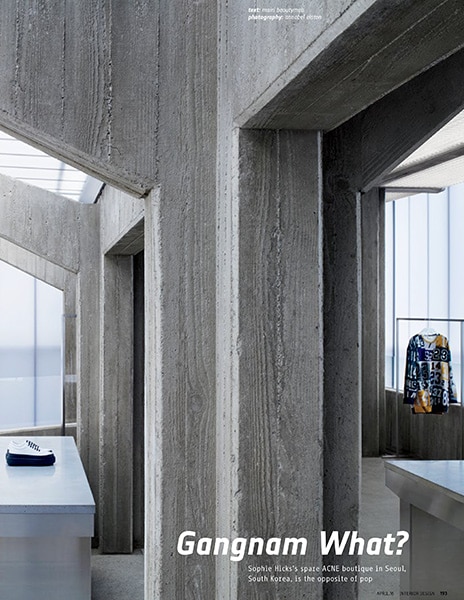
GANGNAM WHAT?
By Mairi Beautyman
Photographs by Annabel Elston
April 2016