
JOONGANG SUNDAY
SOPHIE HICKS
Interview by Hyung Mo Jung
October 2015
English architect Sophie Hicks is considered a master of staging—whether in the luxury retail sector, in museums, or for exclusive private homes. Her life and career are defined by a constant interplay between her uncompromising style and the like-minded people it attracts—people who, in turn, inspire her.
It all started in the 1970s at Harper’s & Queen, later Harper’s Bazaar. Back then there was an issue called the Teenage Issue, which was supposed to be made by teenagers for teenagers. I wrote a letter to the editor, sent my photo – and was invited for an interview. This led to an ongoing collaboration. When I was just 17 I was designing four pages a month and later became an assistant fashion editor, earning £50 a week.
Hamish Bowles, now Global Editor at Large at Vogue, was also involved in this Teenage Issue, as were many others who are now writers and actors. I later moved to Tatler magazine, where my assistant was Camilla Nickerson, who is now considered one of the most influential stylists working today. Back then, unlike today, people didn’t apply with CVs. Opportunities just presented themselves.
Like my collaboration with the fashion designer Azzedine Alaïa: I once sat at lunch in Paris with the then US Vogue creative director Grace Coddington, which Azzedine also attended. He asked us if we wanted to come to the Fashion Oscars that evening, a once-in-a-lifetime gala that was broadcast live on television in 1985. We have to dress up though – it’s a big deal. At that time I owned exactly six white shirts and six black pants. He took us to his studio and picked something out for us. For me he chose a black chiffon coat with a wide belt. I was supposed to wear a black dress underneath. I was skeptical because I never wore dresses. I had my own style: As a teenager in the late 70s in England, everything was very male-dominated. Women were supposed to look decorative above all else and adorned themselves for men. I didn’t want that. So I started wearing men’s clothes – it separated me. I took Azzedine’s coat to the hotel, tried it on and thought: No chance! Especially since I only had hiking boots with me. I put my white shirt and pants back on, but threw the coat over them and buckled the belt.
Lo and behold: Azzedine Alaïa was thrilled. Because when you sew chiffon, it is doubled, which creates black lines along the seams. These were visible through my white shirt underneath. He liked this so much that he developed a whole series based on this effect in his next collection. He was a genius, loving and very funny. From him I learned attention to detail – there is no mediocrity in my work.
After years in fashion, I had become estranged from the magazine world, but wanted to continue working visually. I thought directing would be a good idea and applied to be Federico Fellini’s assistant. He said that wasn’t possible, but offered me a role in his film Interview – a kind of retrospective of his film career.
I then studied architecture and then stayed connected to the fashion world, designing stores for Acne Studios, Paul Smith and Chloé. For this task I also have to communicate with creative directors. And I have to think deeply about the identity of a brand, because it remains, even if the creative direction may leave. It’s not just about the past. Like that what the future of a brand should look like is at least as important. When I worked with Phoebe Philo for Chloé, the house was in slumber – and she revitalized it. Her attitude was very modern and formative, and her feedback to me was precise and intelligent. She was great to work with and we ended up building around 100 stores for Chloé.
Teamwork is central to brand projects. I also love that a brand’s identity has nothing to do with my personal taste and I’m good at translating it credibly into a spatial concept. I think a lot about what helps people feel comfortable and grasp the idea behind a Maison.
This year, for instance, I redesigned the Max Mara flagship store on Avenue Montaigne in Paris. The project was all about the power of restraint. The building housing the store—featuring a robust concrete structure from the 1970s—made this possible, offering open, airy spaces spread across two floors. They are connected by a striking orange spiral staircase reminiscent of a DNA double helix. For me, the quintessential Max Mara piece is a timeless camel-colored coat; the orange hue is an exaggerated take on that camel shade. Complementing this are two large, illuminated screens that display real-time photographic images of weather conditions in Reggio Emilia, Max Mara’s hometown. I also used marmorino plaster on the walls and ceilings, along with terrazzo flooring, to infuse the space with Italian flair. Furthermore, it was important to me to incorporate a handcrafted element: a large table made of glass panels from Effetre in Murano—an island in the Venetian Lagoon. These hand-cast panels, streaked with creamy, cloud-like swirls, are set upon a simple frame.
I now live in Venice myself, having spent 38 years in the Northamptonshire countryside. Then came Brexit, and I felt betrayed by the country. Venice is an international village—a highly sophisticated one, mind you—teeming with fascinating people, movement, and energy. Last summer, I collaborated there with the Guggenheim Museum, which hosts a concert every year on Peggy’s birthday. I brought together three friends for the occasion: Karole Vail, the museum’s director, and pianists Pavel Kolesnikov and Samson Tsoy. I also handled the lighting design.
I have two daughters and a son. I designed a contemporary country house for a daughter, the model Edie Campbell. It’s called House Between the Lakes. Edie had found a property in Northamptonshire that had two small lakes separated by only a narrow strip of earth. We placed the house on it, for which I used corrugated fiberboard. It looks like a traditional farm building – almost like a shed – but is actually a very sophisticated structure with floating canopies.
I would like to design a hotel. A good hotel is a place where you enter a small world created by someone else. All you should ideally bring with you is what you have in mind – and a small suitcase. Nothing more.

SOPHIE HICKS
Interview by Hyung Mo Jung
October 2015

SOPHIE HICKS
by Alain Elkann
April 2023
EDITION No.9, SUMMER 2024
Photography by Johnnie Shand Kydd
Interview by Emily King
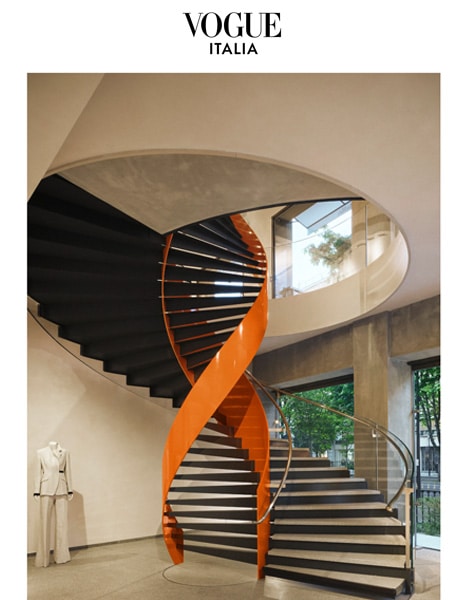
INTERVISTA A SOPHIE HICKS
Words by Sennait Ghebreab
Photography by Adrian Gaut, Alasdair McLellan, Hong Kiwoong and Shin Hyo Geun
June 2026
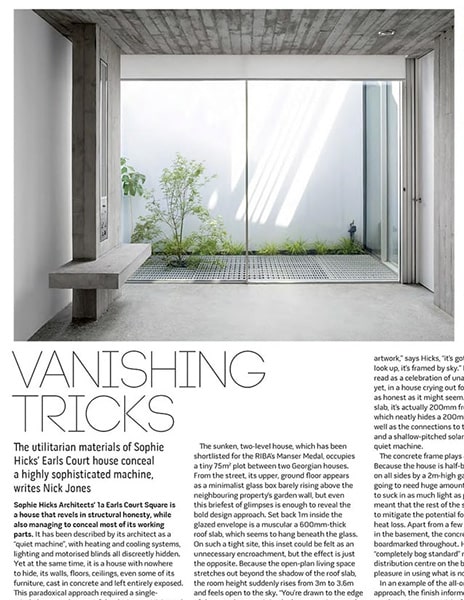
VANISHING TRICKS
by Nick Jones
Photographs by Annabel Elston and Sophie Hicks Architects
Winter 2019

IL CEMENTO GENTILE / COUNTRY DREAM
by Paola Menaldo
Photos by Adrian Gaut
March 2022

THE ART OF LOOKING
By Deyan Sudjic
Photographs by Lee Funnell
March 2001

By Suzy Menkes
November 17, 2008

ACNE STUDIOS
Interview by Park Sungjin
Photo by Annabel Elston
January 2016
A Film. Seoul, Korea.
February 2026